
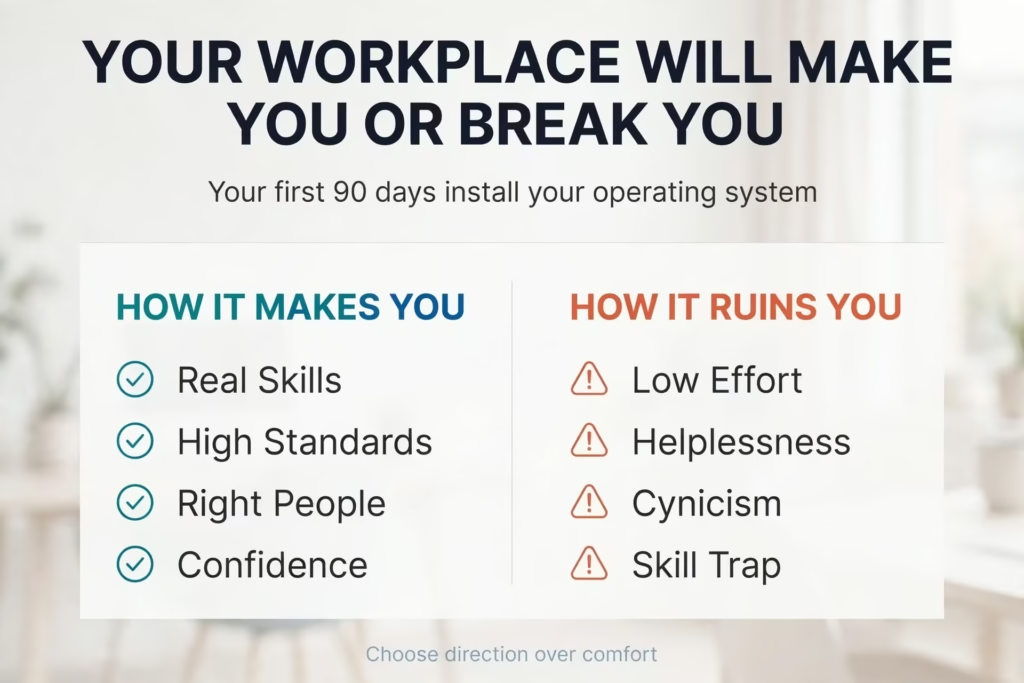
Listen, I need to tell you this straight because no one told me this when I started. Your first workplace is not just a place where you go to earn money. It is the place that will build your brain for the next 10 years. Like, seriously.
Think about your phone. When you buy a new phone, it comes with an operating system. That system decides how fast the phone will run, what apps will work, how it will handle problems. Your first job does the same to you. In the first 6 months, it quietly installs how you will think, how you will talk, how you will handle pressure, what you will think is normal. And you won’t even notice it happening.
That’s why two people who started with the same degree, same marks, same talent – after 3 years one is flying and one is stuck. It’s not luck. It’s what their first workplace installed in them. Let me break it down for you like a friend would.
How a good workplace MAKES you
It makes you in 4 ways, slowly, every day. First, the skills. Look, there are two types of skills. One type is useful only inside that one office. Like you learn how to use their old software, how to make your boss happy, how to fill their weird excel sheet. The day you leave that job, those skills die. They have no value outside.
The second type is real skills. Skills that any company in the world will pay for. Like how to write a clear email so anyone understands. How to break a big confusing problem into small pieces. How to finish something on time without someone pushing you. How to talk to a client and make them trust you. How to learn something new quickly on YouTube or Google and then actually use it.
A good workplace forces you to learn the second type. Even if it’s hard. Even if you feel stupid at first. You will thank them later because 5 years later, those skills are still paying you.
Second, the standard. This one is dangerous. You become like the people you sit with. It’s automatic. If you sit in an office where everyone comes late, does half work, copies and pastes, blames others – after 2 months you will think that is normal. You will start doing the same. You will lower your own bar without knowing.
But if you sit where people are serious, they come on time, they prepare before a meeting, they don’t make excuses, they help each other – you will automatically go up. You will feel ashamed to do low quality work. That pressure is good for you. Your standard is not what you think in your head. Your standard is what you see every day around you.
Third, the people. Man, the guys you eat lunch with at 23 are the guys who will give you a job at 30. That’s real. In a good workplace, you will meet 2-3 people who are going somewhere. They read, they learn, they talk about ideas, not just gossip about other people. If you stay close to them, they will pull you up. They will tell you about a better job, they will teach you how they think, they will tell you when you are doing something stupid. That network is more valuable than your salary.
In a bad workplace, the network is just complaint. Everyone sits and complains all day. Boss is bad, company is bad, country is bad. If you sit there, you also become a complainer. And complainers never grow.
Fourth, the story you tell yourself. This is the most important. After a few months in a good place, you start to believe, “Okay, I can figure this out. If I don’t know, I will learn. I can handle this.” That confidence is small at first but it grows. And once you have it, you carry it to the next job, next city, next life problem.
In a bad place, you start to believe the opposite. You start to say, “I’m just an average guy. I just have to do what I’m told. I can’t do big things.” That story will kill you more than any low salary.
How a bad workplace RUINS you
It never ruins you in one day. It ruins you like slow poison. You won’t even feel it until 2 years are gone.
First way it ruins you – it makes low effort normal. At first you join with energy. You want to do good work. But then you see no one cares. You do extra work, no one says thank you. Someone who does nothing gets the same salary. So your brain says, “Why should I try?” So you stop trying. You start doing just enough to not get fired. And once you learn that habit of doing half work, it follows you everywhere. Even in your own business later, you will do half work.
Second way – it teaches you helplessness. You have an idea, you say it in a meeting, boss says “shut up, do what I told you.” You try again, same thing. After 4-5 times, you stop giving ideas. You just become a robot. You wait for orders. That is the most dangerous habit. The world outside pays for people who can think, not for people who can only wait for orders. But that workplace trained you to wait.
Third way – it makes you cynical. You start to think all jobs are bad, all bosses are cheaters, all companies are scams, hard work is useless. You hear this every day in tea breaks. “This country has no future, this company will never grow, that guy got promotion because of politics.” If you listen to this every day, you will become a negative person. And trust me, no good opportunity ever comes to a negative person, because negative people push it away.
Fourth way – it traps you in useless skills. You become an expert in something that has no value outside. Like you become super fast at some old internal software that no other company uses. Or you become expert at handling your boss’s mood. You feel like you are experienced, but when you go to an interview outside, you have nothing to show. Then you feel stuck. You think, “I have 2 years experience but no one is hiring me.” It’s not because you are bad, it’s because your experience is not portable.
And the worst part? A bad workplace makes you tired in a different way. After a good day at work, you are tired but you feel alive, you have stories to tell. After a bad workplace day, you are tired and empty. You come home and you don’t want to talk, you don’t want to learn, you just want to scroll. If that is happening to you, that is a red signal.
Why the START is everything
Let me tell you why the first few months are so important.
When you join a new place, your brain is in learning mode. Like a kid. You don’t know what is normal there, so you accept everything as normal. If people shout there, you think shouting is normal in offices. If people learn every day there, you think learning is normal in offices.
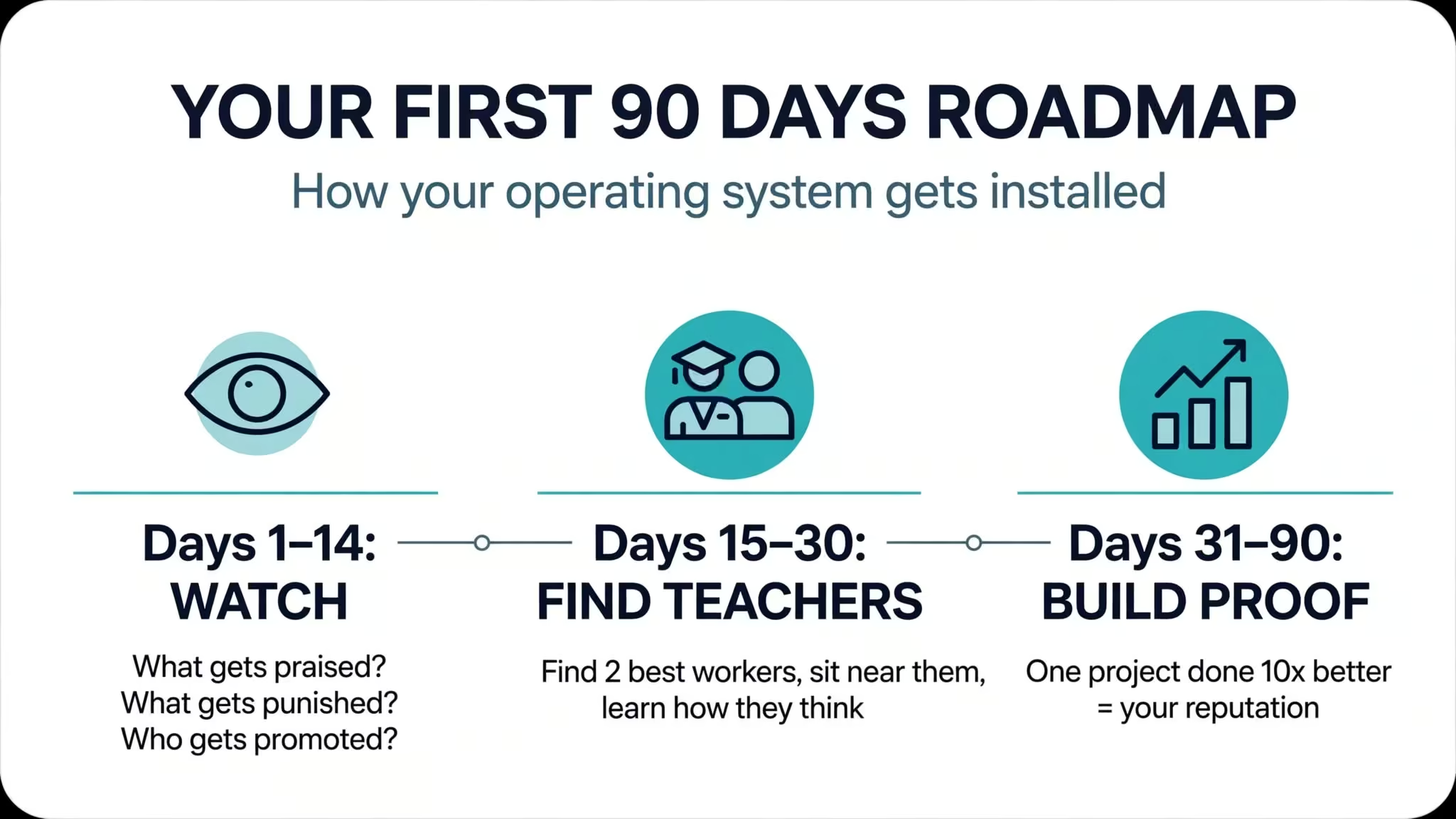
Scientists say the first 90 days set your pattern. After that, you go on autopilot.
So if you start in a place where mediocrity is normal, your autopilot will be set to mediocrity for years. You will have to work very hard later to change it.
That’s why your first job choice is not about salary. I know money is important, especially for us. But in the first job, you should look for where you will learn more, where your standard will go up, where you will be near better people. A little less salary is okay if you are learning real skills. Because those real skills will give you 10 times more money after 3 years.
So what should you actually do? Like practically?
If you are about to start or you just started, do this.
In the first two weeks, just watch. Don’t talk too much. Watch like a detective. See what gets praised. Is it good work that gets praised or just buttering the boss? See who gets promoted and why. Is it the hard worker or the politician? See how people talk when the boss is not in the room. That will tell you the real culture, not what they wrote on the website.
In the next 30 days, find your teachers. No one will assign you a good mentor. You have to find them. Find the 2 people in that office who do the best work. Not the loudest, not the most senior – the best. Sit near them. Eat lunch with them. Ask them simple questions. “Bhai, how did you make this report so clean? How do you manage so much work?” Most good people love to teach if you ask humbly. Stay away from the gossip group in this period, even if it’s fun. That gossip group will eat your future.
In the first 90 days, build one proof. Don’t try to change the whole company. Just pick one small work, one small project, and do it 10 times better than expected. Make it so clean, so on time, so well thought out that people notice. That one project will become your name. People will say, “Oh, that new guy? He did that project, it was solid.” That reputation will protect you for one year.
And every day, ask yourself 3 questions before sleeping:
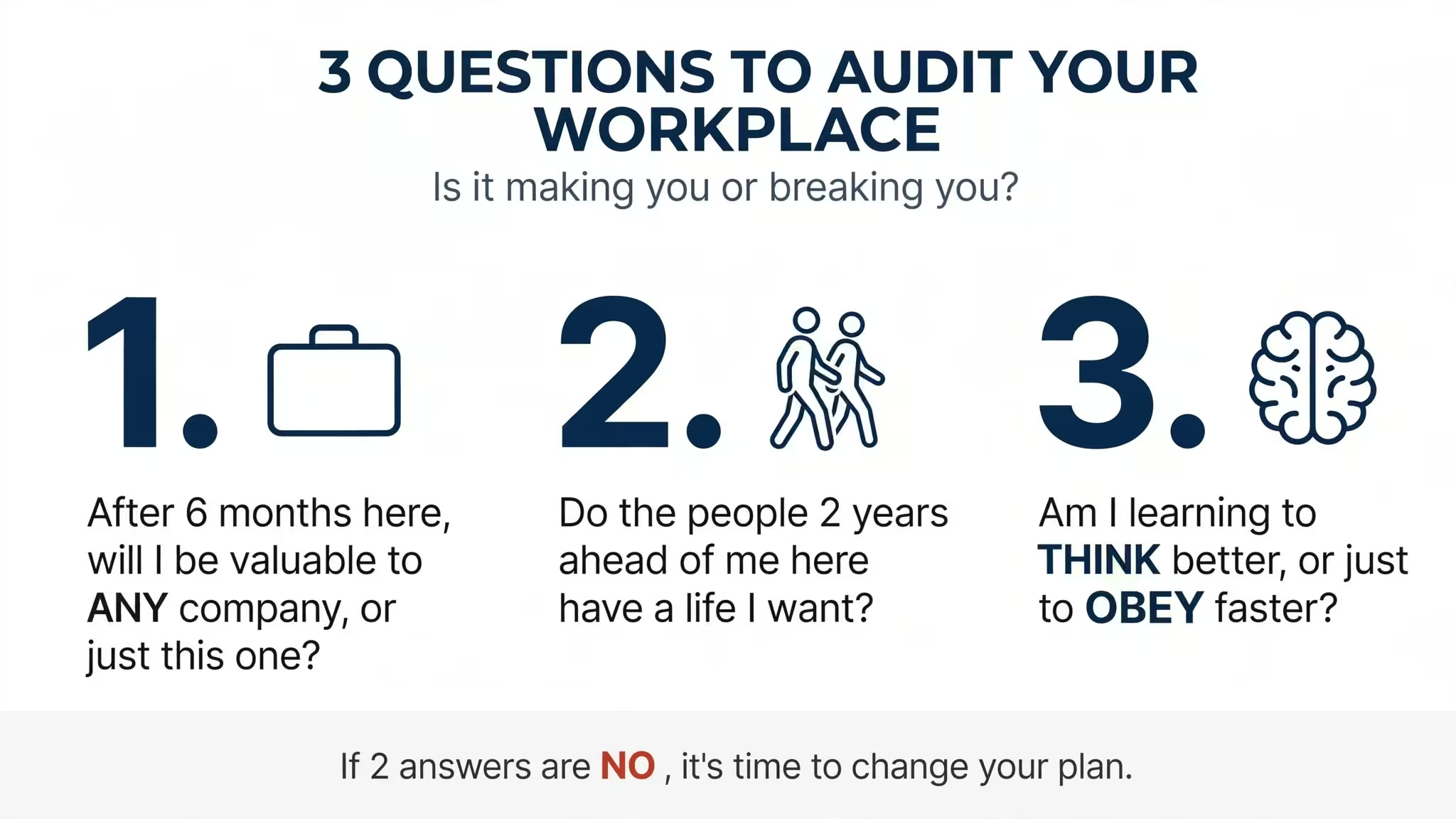
- If I stay here for 6 months, will I be valuable to any company outside, or only to this company?
- The people who are 2 years ahead of me in this office, do I want their life? Do I want to be like them?
- Today, did I learn to think better or did I just learn to obey faster?
If the answer is no, no, and obey – you need to make a plan.
Now, what if you are already stuck in a bad place? Don’t just quit tomorrow with emotion. That’s risky. Do this instead. First, protect your mind. Stop sitting with the complainers. Even if you sit alone, it’s better. Use your earphones, listen to something good while working. Don’t let their cynicism enter you.
Second, create your own university after office. The office is not teaching you? Fine. Give yourself 1 hour every day. 1 hour only. Learn a real skill that your office will never teach you. It could be Excel advanced, or English writing, or video editing, or coding, or digital marketing, or whatever has market value. In 6 months, you will have a new skill. That skill is your ticket out.
Third, start documenting your work in a way that outsiders understand. Don’t write “Managed internal XYZ portal.” Write “Solved 30 client problems per week, reduced response time by 20%.” Make your experience sound real to outsiders.
And finally, never let a bad workplace make you a bad person. It’s easy to become rude, lazy, dishonest because everyone is like that there. Don’t. Keep your own standard even when no one is watching. That self respect is what you will take with you when you leave. Look, at the end of the day, no workplace is perfect. Everywhere has some politics, some boring work, some bad days. That’s normal.
But there is a big difference between a tough workplace that makes you stronger, and a toxic workplace that makes you smaller.
A tough workplace says, “This is hard, you need to level up.” You come home tired but proud.
A toxic workplace says, “You are small, just stay quiet.” You come home tired and empty.
You need to find the first kind, even if it pays a little less at the start. Because your start is not just a start. It is the direction. If your direction is right, even if you walk slow, you will reach far. If your direction is wrong, the faster you run, the further you go from where you actually want to be.
So take your start very seriously, my friend.
FAQ
Q1: What are signs of a toxic workplace?
A toxic workplace ruins you slowly. 4 clear signs: 1) Low effort is normal – people who do extra work and people who do nothing get the same reward. 2) Helplessness – you give ideas but boss says do what I told you, so you stop thinking. 3) Cynicism – everyone gossips, complains about boss, company, and promotion politics in tea breaks. 4) Skill Trap – you become expert in old internal software or handling boss mood that has zero value outside. The biggest red signal is you come home tired and empty, not tired and proud.
Q2: How to survive first 90 days at a new job?
Your first 90 days install your operating system. Don’t try to change everything. Follow this roadmap: Days 1-14 WATCH – see what gets praised, what gets punished, who gets promoted to understand real culture. Days 15-30 FIND TEACHERS – find 2 best workers, sit near them, eat lunch with them, ask how they think. Days 31-90 BUILD PROOF – pick one small project and do it 10x better than expected. That one project becomes your reputation. Every night ask the 3-question audit: Will I be valuable to any company after 6 months here, do I want the life of people 2 years ahead, and am I learning to think better or just to obey faster.

As a Technical Recruiter and Career Guide, I help professionals find the right opportunities and navigate the hiring process with confidence.
My work involves sourcing, screening, and matching qualified candidates with technical roles based on their skills, experience, and career goals. I believe recruitment is more than filling vacancies. It is about connecting people with opportunities that help them grow and move forward in their careers.
I share practical advice on job searching, interview preparation, workplace culture, office politics, bosses and managers, career growth, and the everyday challenges of working life. Through my experience and knowledge sharing, I aim to make career guidance simple, honest, and useful, helping job seekers prepare for interviews, make informed decisions, and build better professional lives.